What AI Search Visibility (GEO) is
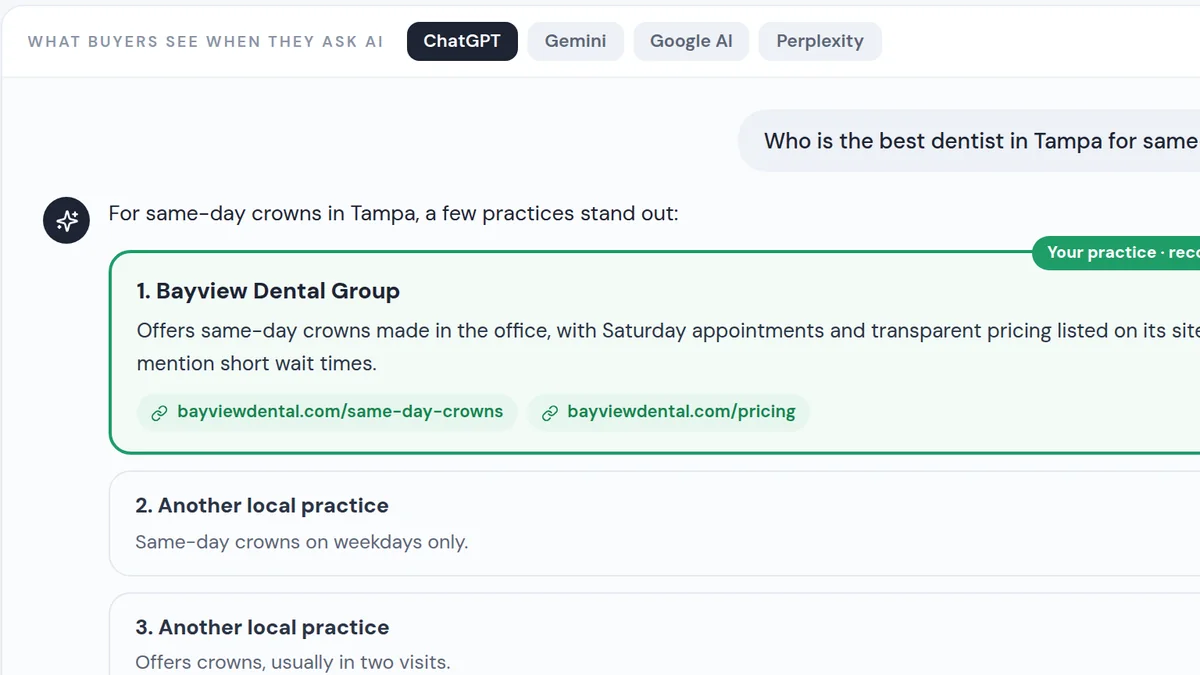
GEO is SEO for AI answers. When someone asks an assistant "who is the best roofer near me for hail damage?" or "what software helps HVAC companies answer calls?", the assistant pulls from pages it can read and trust. GEO makes your business one of those sources.
In practice it is a handful of unglamorous jobs done well: clear pages that state what you do and where, structured data search engines can parse, answer-first content built around real buyer questions, consistent facts across the web, and machine-readable files like a sitemap, an RSS feed and an llms.txt.
There is no button that makes ChatGPT recommend you. Anyone who promises that is selling something. What you can do is make it easy for AI systems to understand and cite you.
What people are using it for
Local service visibility
Contractors and clinics make sure assistants know their service area, services and reviews, so they show up when someone nearby asks.
Comparison questions
Businesses publish honest comparison and "when to use what" pages, which are the pages assistants love to cite.
Answering buyer questions
Turning the questions customers ask on sales calls into clear pages that answer them directly.
Fixing wrong information
Correcting outdated services, prices or locations that AI tools repeat back to buyers.
Why people use it over the alternatives
Traditional SEO optimizes for ten blue links. AI answers often show one or two recommendations and a summary. If you are not in the summary, you are invisible to that buyer, no matter where you rank.
The good news is that the work overlaps with what makes a website useful to humans: clear claims, real answers, honest comparisons and proof. Businesses that do it now are building an advantage that compounds.
| Option | What usually happens | With AI Search Visibility (GEO) |
|---|---|---|
| Old-school SEO retainer | Keyword pages written for algorithms, and reports about rankings. | Answer-first pages written for buyers and the AI tools they ask. |
| Doing nothing | AI tools describe you from whatever scraps they find, sometimes wrongly. | You control the facts AI systems read about your business. |
| Paying for "AI rankings" | Promises nobody can guarantee. | Measurable work: structure, content, consistency and regular audits. |
When you should not use it
- Your website is a single page.Assistants need something to read. If there is almost no content, start by publishing real service and FAQ pages.
- You need leads this week.GEO compounds over months. If the pipeline is empty now, use outbound or reactivation in parallel.
- You won't publish honest content.AI tools reward clarity and credibility. Hype-filled pages with fake reviews are a liability, not an asset.
Tactics that make it work
Ask the assistants about yourself
Before changing anything, ask ChatGPT, Gemini and Google's AI what they know about your business and your category. That is your baseline.
State the facts plainly
Who you serve, where, what you do, and what it costs or how pricing works. Ambiguity is the enemy of being cited.
Turn sales-call questions into pages
Every question you answer on a call is a page a buyer is asking an AI. Write the answer once, publicly.
Publish comparisons honestly
Pages that say when a competitor or a cheaper option is the better choice earn trust from humans and machines.
Make it machine-readable
Keep a clean sitemap, structured data, an RSS feed and an llms.txt file that points to your most important pages.
We run it on simpliscale.io first
Everything on this page is something we do on our own site. simpliscale.io has an llms.txt file that lists our services and guides in plain language, a sitemap and RSS feed that update with every post, and structured data on every article. We run recurring audits that check what is published against what search and AI tools can actually read.
This solutions library is part of the same strategy. Each breakdown answers the questions buyers ask: what it is, when to use it, when not to. That last part matters. Pages that admit limits read as credible, and credible pages are the ones that get cited.
Buyers increasingly get a short list from an AI assistant and call from there. The businesses on that list did the work to be understood. Everyone else is competing for the leftovers.
If you are a business owner who wants inbound demand that doesn't depend on ad spend, making your business easy for AI to understand and cite is one of the highest-leverage, longest-lasting moves you can make.
- Show up when buyers ask AI who to hire
- Control the facts AI tools repeat about you
- Build an advantage that compounds instead of renting attention
for you?
On a short, personalized call we'll look at how your business runs today and show you how this would plug into your leads and tools. You'll get a straight answer on whether we can help you get similar results, and what it would take to get recommended when buyers ask AI who to hire.
- Personalized to your business
- See the system working
- Honest answer on fit