What CRM & Pipeline Automation is
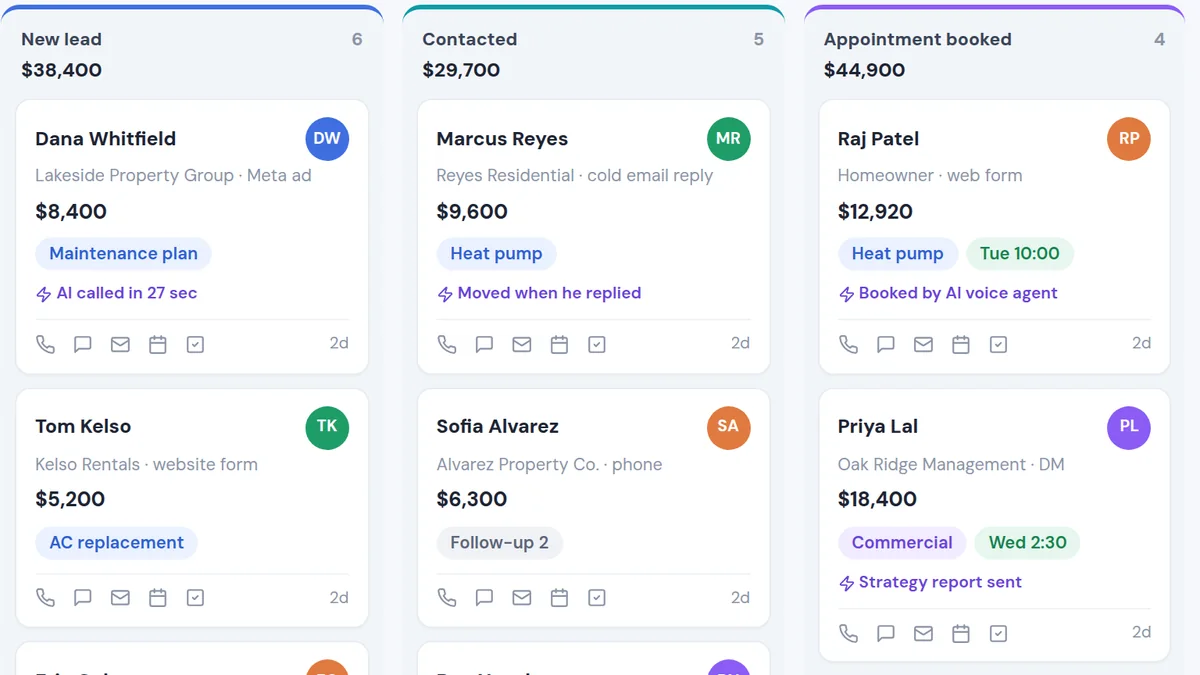
CRM & Pipeline Automation in the SimpliScale platform keeps contacts, deal stages, ownership, activity and next actions in one shared view. You set stages that match how you actually sell, and every opportunity has an owner and a next step.
The difference from a standalone CRM is that the rest of the platform feeds it. Calls from the dialer, AI follow-up, bookings and conversations update the record automatically, so the pipeline reflects reality without reps doing data entry.
A CRM only works if people trust it. It earns trust by being accurate without extra effort.
What people are using it for
Weekly pipeline reviews
Owners and managers run one meeting from one view and see exactly which deals need help.
Clear ownership
Every opportunity has a named owner, so nothing falls between reps.
Automatic activity history
Calls, messages and meetings attach to the contact without anyone typing notes.
Multi-step customer journeys
Businesses with onboarding or patient journeys track people from first inquiry to active client.
Why people use it over the alternatives
Most CRMs fail because they create work. Reps are asked to log everything by hand, they don't, and soon the data is wrong and nobody uses it. A pipeline that updates itself from the tools people already use stays accurate.
When the pipeline is accurate, the owner stops being the only person who knows the state of the business. That is the first step to stepping out of the middle of every deal.
| Option | What usually happens | With CRM & Pipeline Automation |
|---|---|---|
| Spreadsheet pipeline | Out of date by Wednesday; only one person really understands it. | A shared live view anyone on the team can use. |
| CRM nobody updates | Data entry is skipped, so the data is wrong. | Calls, messages and bookings update records automatically. |
| Five disconnected tools | Leads, calls and bookings live in different places. | One record per customer across the whole journey. |
When you should not use it
- You haven't defined your sales process.A CRM mirrors your process. If you can't describe your stages, do that on paper first.
- You need a heavily regulated system of record.Some industries require specialized, certified systems. Integrate with them instead of replacing them.
- Nobody will own it.Someone has to own stage definitions, data hygiene and the weekly review. Without an owner, any CRM decays.
Tactics that make it work
Use as few stages as possible
Each stage should mean a real change in the deal. Five to seven clear stages beat fifteen vague ones.
Require a next action
No open deal should exist without a next step and a date.
Automate the logging
Connect calls, messages and bookings so reps never type what a system already knows.
Review the stuck deals
In the weekly meeting, focus on deals that haven't moved, not the ones that are going well.
Migrate clean, not everything
When moving from an old system, bring over active and recent records and archive the rest.
From one location to five, with nothing falling through the cracks
“Working with Nick and the SimpliScale team has honestly been one of the most important pieces of building Club Five to where it's at now. That level of customization made us feel like we had a ginormous team working with us.”
Club Five Health is a health, wellness and longevity center that started in a single location in Green Bay, Wisconsin. Ads, website traffic, lead forms and follow-up all lived in disconnected systems, and too much of the patient journey depended on manual work. We rebuilt their CRM and full patient-journey management and tied their ads, site and follow-up sequences into one funnel.
Club Five scaled from one location to five across the Midwest and is still growing. The automation stack saves the organization about $300,000 a year and 67 hours a week. The CRM was the foundation: when every person in the journey has a record, a stage and a next step, you can add locations without adding chaos.
AI systems now log calls, summarize conversations and book meetings. There's no reason a sales team should still be typing notes into a CRM after every call. The pipeline should reflect reality on its own.
If you are an owner who wants to grow without being the only person who knows where every deal stands, a connected pipeline is the foundation every other system on this page plugs into.
- One shared view of every deal and owner
- Activity logged automatically from calls, messages and bookings
- A foundation for growth that doesn't depend on you
for you?
On a short, personalized call we'll look at how your business runs today and show you how this would plug into your leads and tools. You'll get a straight answer on whether we can help you get similar results, and what it would take to see and move every deal without chasing your team.
- Personalized to your business
- See the system working
- Honest answer on fit